A Change in Demeanor
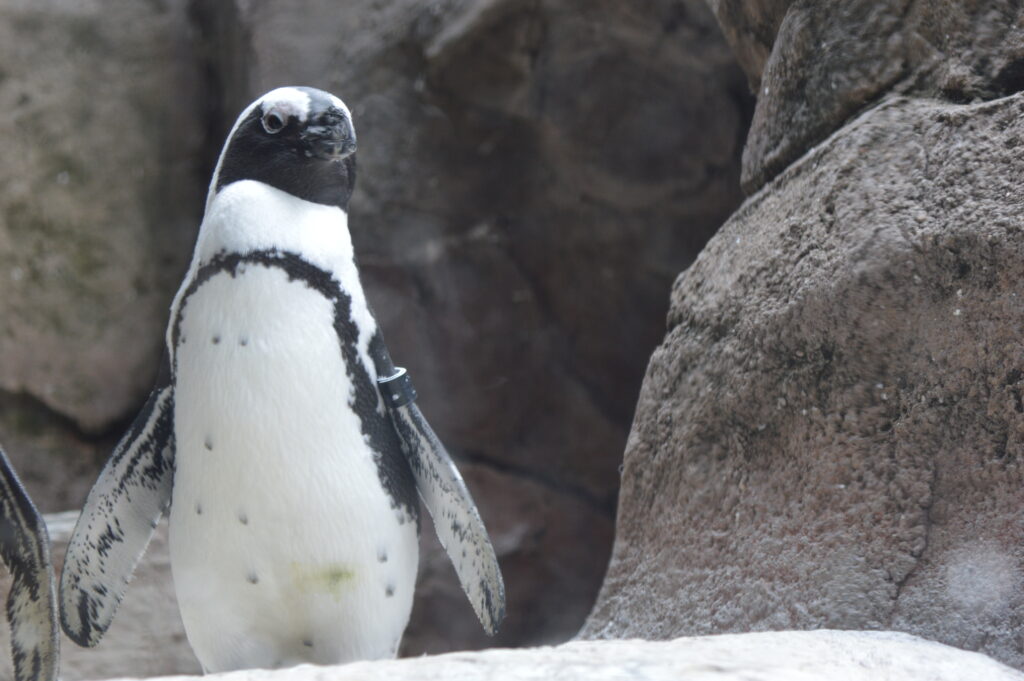
When Dottie the African Penguin fell ill, the National Aviary’s animal care team immediately took notice. This usually friendly and sweet penguin was suddenly lethargic and weak, unable to stand, and experiencing labored breathing.
Fortunately, the National Aviary is home to a state-of-the-art Veterinary Hospital, where our teams provide high-level, comprehensive care for birds spanning from Andean Condors all the way to Owl Finches, through every life stage.
Dottie’s Treatments
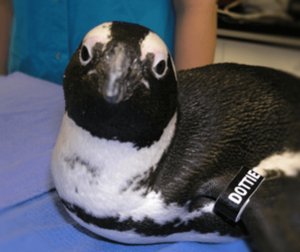
Dottie was immediately admitted to our hospital’s ICU. Dottie received oxygen and emergency treatments along, where a battery of tests determined her symptom’s causes: pneumonia and a mass in her chest.
Faced with this difficult diagnosis, we assembled an expert team made up of our veterinary care, penguin behavior, and husbandry staff. Dottie’s treatment was intensive and thorough.
She received human-grade antibiotics and nebulization, treatments pioneered by the Dr. Pilar Fish, the National Aviary’s Senior Director of Zoological Advancement and Veterinary Medicine.
Dottie took nebulizer treatments every four hours, alongside twice-daily medications and a steady intake of daily fluids. With intensive nursing, slowly but surely, Dottie regained her strength and made strides towards recovery.
But there was something, or rather, someone missing in Dottie’s recovery. Penguins are social birds who live in colonies. They often pair with the same partner for years at a time. Dottie’s care team knew what she needed to fully recover: companionship.
A Tale of Two Mates
Cue the arrival of Stanley (named for the Stanley Cup), Dottie’s mate, and one of the National Aviary’s four original African Penguins.
Stan started visiting Dottie in the ICU each day, at first for only an hour at a time. As Dottie gradually regained her strength, Stan’s visits got longer. Eventually, Stan moved in to be with Dottie in the ICU full time.
“Stan worked in tandem with the team to encourage Dottie to eat. While our experts would feed Dottie, Stan would sit right there, vocalizing and grooming her. When Stan ate, Dottie would take a bite,” said Dr. Fish.
Returning Home
Dottie’s health improved to the point where she was declared fully recovered and ready to return to Penguin Point! When she and Stanley returned to their colony, they were met with a chorus of brays and calls. The pair made their way back to “their” cave and fell back into their old routines, enjoying being back home after a long journey.
Watch their full story below…
Learn more about we help birds like Dottie by visiting our Veterinary Hospital page.
Learn more about how you can help birds like Dottie by visiting Donate.